
The Three Seas - Antaḥkaraṇa
Released 20 February 2026, via CD, LP and digital
Raju Das Baul - lead vocal, khamak
Matt Keegan - baritone sax, harmonium, vocals
Deo Ashis Mothey - lead vocals, dotora, acoustic guitar, esraj
Brendan Clark - electric bass, dotora, vocals
Gaurab Chatterjee - lead vocals, drums, dubki, acoustic guitar
Additional Musicians
Dave Rodriguez - electric guitar & fx
Hilary Geddes - backing vocals track 10
Amy Curl - backing vocals track 4
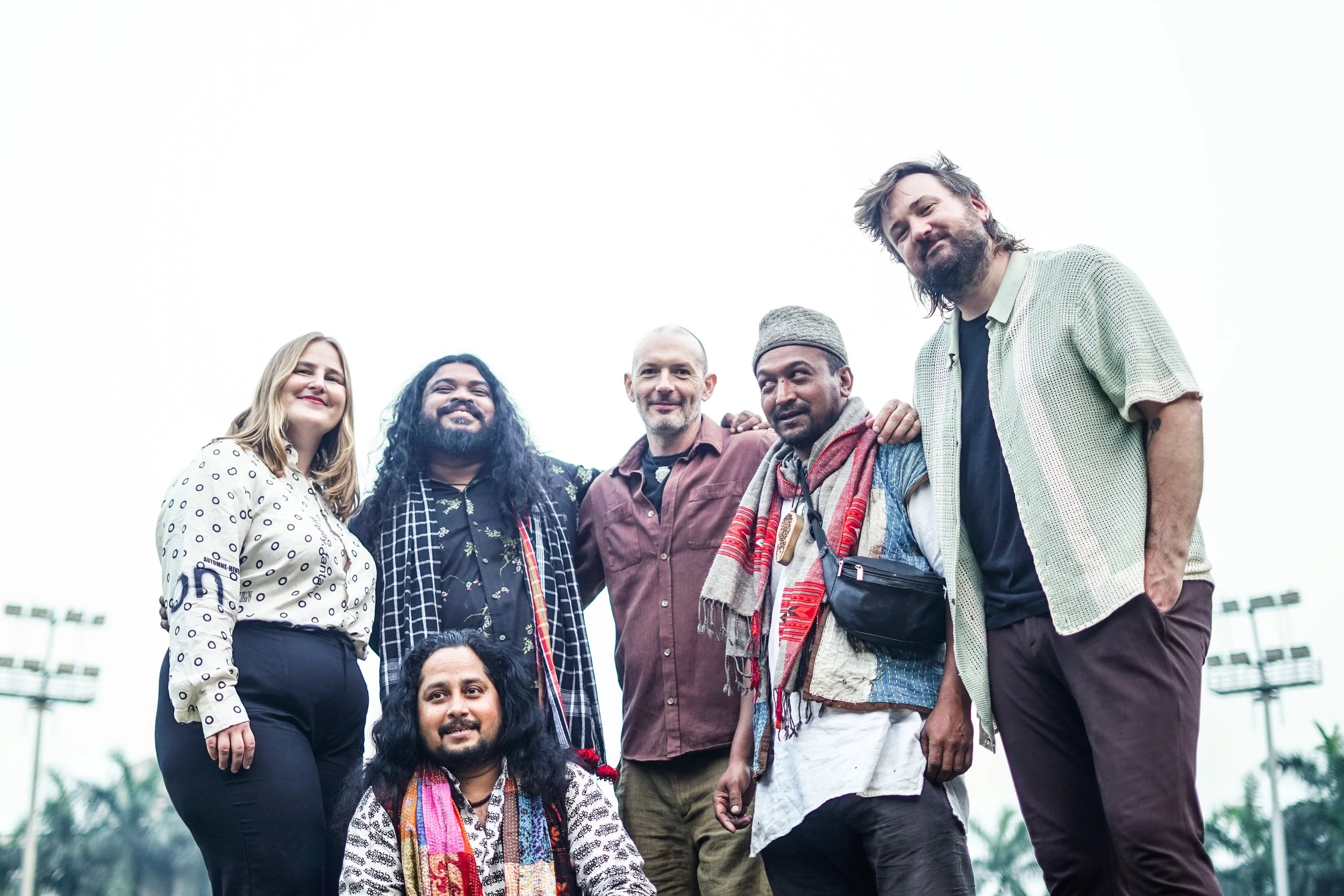
Bengali-Australian ensemble, The Three Seas return with their most expansive and spiritually charged work to date. ‘Antaḥkaraṇa’ is a luminous meeting of Baul mysticism, Himalayan folk, rock and dub, recorded at Peter Gabriel’s legendary Real World Studios in the UK.
The title ‘Antahkarana’ — Sanskrit for “inner instrument” — refers to the meeting place of memory, intuition, identity and soul. It reflects the band’s belief in music as a bridge between worlds: ancient Baul poetry sits inside dub grooves, Nepali folk melodies entwine with baritone sax riffs, and Bengali chants resonate beside rock and electronica. The result is hypnotic, trance-like, and alive — music that feels both ritualistic and contemporary, spiritual and bodily.
‘Antaḥkaraṇa’ fuses ancient devotional poetry with hypnotic grooves and global improvisation, uniting Raju Das Baul (lead vocals, khamak), Deo Ashis Mothey (vocals, dotora, esraj, guitar), Gaurab “Gaboo” Chatterjee (vocals, drums, dupki, guitar), Brendan Clark (electric bass, dotora, vocals) and Matt Keegan (baritone saxophone, harmonium, vocals). Additional performances include Dave Rodriguez (electric guitar and FX), Hilary Geddes and Amy Curl (backing vocals).
The project took shape in August 2022, following a ten-day residency at the Edinburgh Fringe Festival. “We performed every day and wrote every night,” recalls Keegan. “Then we travelled straight to Real World to record. That immersion — living inside the music — gave the album its pulse.” Producer Sarathy Korwar brought a fresh UK/India lens, while long-time collaborator Richard Belkner captured the enormity of Real World’s Big Room with engineer Dom Shaw. Post-production took place in Australia with George Sheridan (mixing/mastering) and Dave Rodriguez, resulting in a panoramic yet organic soundscape.
“Recording Prithibi in the Big Room — a song written by Gaboo’s father, Gautam Chattopadhyay, pioneer of Indian fusion — was electric,” says Keegan. “We felt the weight of history and the joy of carrying it forward.” Despite the pandemic’s disruption — including a cancelled Tokyo Jazz Festival debut — the project rebounded with renewed purpose: “Antahkarana was our quantum leap,” says Gaboo. “It’s not about fusion for fusion’s sake. It’s a true meeting of worlds.”
Formed in Santiniketan, West Bengal, in 2009, The Three Seas grew out of an all-night jam between Australian saxophonist Matt Keegan and local musician Raju Das Baul, Gaurab Chatterjee from Kolkata and Deo Ashis Mothey. Over 15 years, the group has evolved into one of the most distinctive cross-cultural ensembles in contemporary music. Their previous releases — Haveli (2013), Fathers, Sons & Brothers (2017), and Afterlife (2022) — earned acclaim from The Sydney Morning Herald, OzAsia Festival, and The Times of India, who praised their sound as “a rare sound of joy.” From Rajasthan’s desert courtyards to the legendary halls of Real World Studios, The Three Seas continue to build bridges between ancient traditions and modern expression, creating music that transcends borders and speaks directly to the soul.
Produced by acclaimed UK-based artist Sarathy Korwar, and shaped by Dave Rodriguez and Matt Keegan in post-production, Antahkarana continues The Three Seas’ 15-year exploration of transcultural collaboration. From the desert courtyards of Rajasthan (Haveli, 2014) to Kolkata’s folk-rock lineage (Fathers, Sons & Brothers, 2017) and global festival stages (Afterlife, 2022), the group has forged a sound described as “an entirely original modernity” (Sydney Morning Herald), “the sort of work that tips music into the spiritual” (OzAsia Festival), and “a rare sound of joy” (Times of India).
‘Antaḥkaraṇa’ means “the inner instrument”; a bridge between thought and feeling, body and spirit. It signifies the field where mind, memory, ego, and intuition intersect: the unseen current connecting consciousness to the senses. It is the subtle mechanism through which the inner self experiences and interprets the external world. Music follows this same pathway, translating emotion and intuition into sound.
‘Antaḥkaraṇa’ was funded by SoundNSW, Creative Australia and sponsored by Freedman Foundation. ‘Antaḥkaraṇa’ releases internationally through Earshift Music on February 20th, 2026.